



Boost your Negotiation Listening Skills
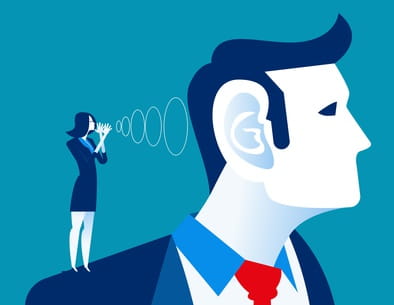
Every negotiator needs good information, which demands that we understand fully what we hear from other negotiators. This article shares how to improve your negotiation listening skills.
‘Do you hear what I hear?‘ That’s the flashing, neon question mark at crucial moments in our negotiations. When negotiators gather together after hearing someone speak, we discover that we often recall somewhat dissimilar versions about what was said. People digest what others tell them and provide their own unique interpretation about what was said to them. We’re typically overconfident of having correctly heard the speaker.
If someone were to tell you that you have to hone-up on your listening skills, you would probably feel a pang of resistance, thinking that your listening skills are already above average. Truth is almost all of us could do with sharpening up our listening skills. You’d think that your hearing was one of the five senses you’ve been using since the cradle, so what can we do to improve our listening skills for negotiating more effectively? You’d be amazed how much we can gain in negotiation skills through sharpening our ears. This article explores how to go about boosting our negotiating listening powers.
What does listening mean?
First, listening is actually broken down into two specific functions. The first obvious function is the reception portion where we receive the message from the person speaking.
The second function of listening is how we decode or interpret the message that we receive. This is the tricky one.
It’s useful that we examine three categories of listening. All of us actively engage in these three forms of listening when someone is speaking to us, and it’s through dissected each negotiation listening skills that we can effectively take advantage to achieve our negotiation goals. In our advanced negotiation courses, listening skills are an important feedback point, shared afterwards with the aid of our advanced camera equipment, with the video rolling on the big screen.
1. Passive Negotiation Listening Skills
Just as the phrase implies, we sit there like a sponge and absorb the message from the sender without any form of active engagement. We do not acknowledge what is being said to us, nor do we provide any feedback that we are absorbing.
Clearly, this underscores the importance of paying attention when we are listening. This strikingly illustrates why a negotiator should not be distracted by looking over or rifling through their notes and files, and not giving the speaker their full and undivided attention.
We are being disrespectful to the speaker when we allow other things to distract us. Distractions will also cause us to miss some important information, or misunderstand a key section of the message. Passive negotiation listening skills requires single-mindedness and concentration.
How else can this blaringly obvious titbit be of use to us?
Consider this possibility – there are people who cannot tolerate long silences. They need to fill in a lengthy silence gap with conversation. They simply can’t keep quiet. When we encounter this sort of person in a negotiation, we may use the tactic of silence. It highly likely that the person may begin a one way dialog, or divulge information that we can use to our advantage. We can learn valuable information and perhaps enhance our agreement. Our negotiating counterparty may even talk themselves, into either accepting or deciding against a position, all on their own.
This type of negotiator is also susceptible to speak when, not having got a satisfactory response from him, all you need do, is remain silent and stare at the person expectantly. The talkative negotiator can no longer tolerate the silence and will begin to add or provide more information. This technique is also referred to as ‘The pregnant pause‘.
2. Acknowledgement Listening Skills
Acknowledgement listening skills involve a slightly more active role in the listening process. It simply means that we provide a sign of recognition to the speaker, by sending them subtle messages. We accomplish this by telegraphing physical or other non-verbal signals to the narrator, to show that we are involved in the listening process. This is a visual clue that is a form of positive engagement and encourages the person who is speaking.
Using this listening skills, it is imperative we make eye contact with the speaker as much as possible. This will give the speaker validity and the confidence that their message is reaching us.
Other physical signals to show that we are tracking the relevant points, include nodding our head, saying ‘mm-hmm‘, or ‘I see‘, or by making other physical gestures such as grinning at a pun.
Physical responses, like frowning or shaking our head, also informs the speaker whether we disagree with their position. This signifies that important issues are being resisted or disputed, and should perhaps be addressed immediately before proceeding further.
3. Active Negotiation Listening Skills
The final form of receiving the counterparty’s message, involves verbal participation and is also referred to as ‘reflective responding‘. Essentially, the skilled negotiator listens and then repeats the phrase back to the speaker by re-phrasing what was said, best done using slightly different wording. For example, we might hear the speaker say something like ‘ I am particularly puzzled about how we are going to resolve the distribution conflict.’ You re-phrase it back to the speaker by saying ‘I understand that you’re stymied by this distribution challenge‘
The majority of times that we use reflective statements, we are making personal reference to the other party’s feelings, positions or beliefs about something. In a sense, we commiserate with the speaker which acts as a bond or an abstract pat on the back as if to say, ‘ I hear you – I understand.’
These type of active negotiation listening skills allows us to follow the speaker, without pressuring them, while permitting us to further explore this line of thought in greater detail. More importantly, we signal to the speaker that we are fully and actively engaged in what they have to share, and we often do so by responding to their feelings.
Conclusion
The listening process described above does not mean or suggest a negotiator should remain passive. We have our own business objectives and positions to put forward and persuade or defend. Effective negotiation skills in the arena of listening allows us to gain valuable information, information we can use to our benefit and advantage. At the same time enabling us to learn more about the other party’s positions and business objectives.Having more information at our disposal also allows us to reach our negotiation goals without conceding as much along the way. These negotiation skills require training in order to enjoy the results, and most of us develop effective listening skills rather than being born effective listeners.
- Max H. Bazerman, Margaret A. Neale, ‘Negotiating Rationally’, The Free Press – MacMillian, (1992).
- J. Lewicki, A. Litterer, W.Minton, M. Sauders, ‘Negotiation’, 2nd Edition, Irwin,(1994).
- Leigh Thompson, ‘The Heart and Mind of the Negotiator-2nd Edition’, Prentice Hall Business Publishing, (2001).

 Rate this Article
4.5 out of 5 from 2 responses
 Loading...
YOU MAY ALSO LIKE







Although a face to face negotiation use to be the norm today in our global markets we find an increasing number of negotiations begin via remote communication ie telephone. this means "Visual Listening" is more important than ever before. Ones ability to build a mental/visual image of the other parties emotional and physical state give you an edge in the negotiation process. For more on this topic visit us at: http://www.Visual-Listening.com